Information for standard organisations
Are you a standard-setting or label-issuing organisation and would like your label to be mapped on Siegelklarheit? We are very pleased about your interest!


- Your label must meet certain requirements to be included on Siegelklarheit.
- Siegelklarheit can assess your label using either a quick check or a detailed assessment.
- Each label assessment process follows a clear, transparent, and comprehensible procedure.
We would like to share some information on the conditions under which a label can be featured on Siegelklarheit and how the general admission process works.
What requirements must a label meet to be included on Siegelklarheit?
Two basic requirements must be met for a label to be included and assessed on Siegelklarheit:
- It must be a voluntary sustainability label – in other words, it must identify products that have been produced in an environmentally friendly and/or socially responsible way. It supports consumers in making conscious purchasing decisions and promotes responsible economic activity.
- It must be visible to end consumers on the product. Siegelklarheit focuses on consumer labels or product labels – that is, labels aimed directly at consumers. In this way, Siegelklarheit supports its overarching objective of providing end consumers with reliable and comprehensive information on which they can base more conscious and sustainable purchasing decisions.
If your label meets these two requirements, it can be examined through the quick check.
How does Siegelklarheit define "sustainability labels" – can labels without a link to sustainability also be included?
No. Labels without a link to sustainability are not listed on Siegelklarheit. Nor are labels that are not visible to end consumers on end products.
Special case: company-owned labels related to sustainability
If label-like symbols have been developed by a company itself and can only be used by that company, Siegelklarheit does not assess them. Such company-owned labels are often not comparable with independently assessed labels. Siegelklarheit provides written information about these symbols only, to help consumers put them into context.
What requirements must a label meet to undergo a detailed assessment?
In addition to the first two requirements above, your label must be assignable to a sector – for example, textiles, paper or computers – for which a sector-specific set of criteria already exists on Siegelklarheit. If there is no suitable set of criteria, your label can only undergo the quick check. The criteria sets can be found in the download area.
If you cannot find a suitable sector on Siegelklarheit, please write to us at kontakt@siegelklarheit.de or use the contact form.
We are continuously working on developing new sector-specific sets of criteria for Siegelklarheit. For example, we are currently creating a set of assessment criteria for the food product group. Therefore, food labels can currently undergo the quick check only.
At a glance:
| Your label is | Assessment |
| Quick check (5 criteria) |
| Detailed assessment (based on ITC-data) |
Admission process
How does admission via the quick check work?
To have your label considered for inclusion via the quick check, simply contact Siegelklarheit and express your interest.
Siegelklarheit will check the first two requirements described above. Your label will then be examined against five basic criteria based on publicly available standard documents.
Once the quick check has been completed, you will be informed of the result.
If your label meets all five criteria of the quick check, it may in future be eligible for a detailed assessment based on data from the International Trade Centre (ITC). This requires you to provide your standard data to ITC (see next section).
How does admission via a detailed assessment work?
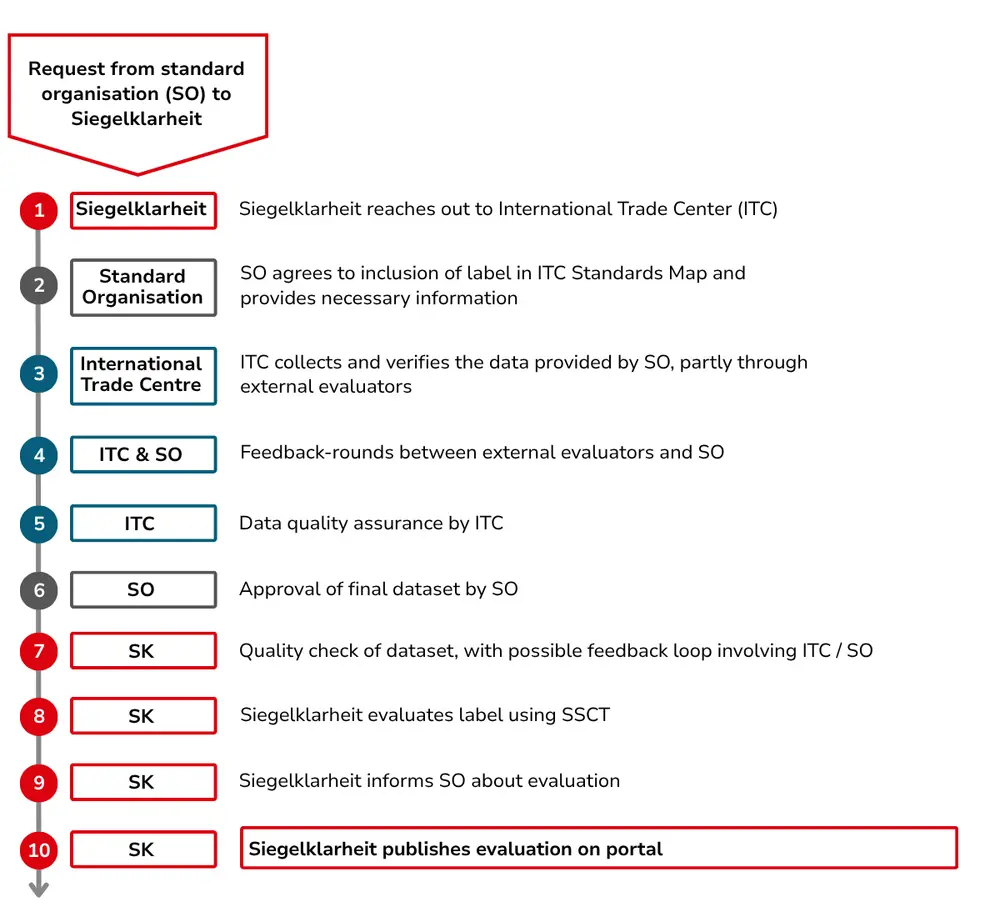
The admission process for a label via a detailed assessment, including data collection with ITC, is described below and shown in the illustration.
- Siegelklarheit first contacts the International Trade Centre (ITC), which acts as a neutral body coordinating the collection and review of your standard data.
- If you agree to your label being included in the ITC Standards Map, you provide the required information and documents.
- ITC collects and evaluates this information, partly with the help of external evaluators.
- ITC may hold feedback rounds with you if needed.
- After ITC has quality-checked the data, you confirm the final dataset for your label.
- Siegelklarheit then reviews the raw data again for quality, if necessary, in consultation with ITC and with you.
- Finally, Siegelklarheit assesses your label using the Sustainability Standards Comparison Tool (SSCT).
- Siegelklarheit informs you of the result before the label is published on the portal.

Verbraucherzentrale NRW / Label inclusion process Siegelklarheit