Assessment methodology and data collection procedure
Siegelklarheit openly shows how existing sustainability labels are assessed – in a transparent and easily comprehensible way.


- Behind the detailed assessment results lies a comprehensive methodology based on objective and transparent criteria: the Sustainability Standards Comparison Tool (SSCT).
- Three areas are used to assess a label: Credibility, Environmental Friendliness, and Social Responsibility. Credibility criteria apply across all sectors, while environmental and social criteria are sector-specific.
- Labels for which there is currently no sector-specific criteria set cannot be assessed at this time.
What is the Sustainability Standards Comparison Tool (SSCT)?
The Sustainability Standards Comparison Tool (SSCT) is used by Siegelklarheit to analyse and evaluate existing sustainability labels.
The SSCT was developed in 2013/2014 through a multi-year, multi-stakeholder process by the Deutsche Gesellschaft für Internationale Zusammenarbeit (GIZ) in collaboration with national and international experts on behalf of the German Federal Ministry for Economic Cooperation and Development (BMZ). The methodology was comprehensively revised in 2020/2021 to make it leaner, more transparent, and easier to understand – without losing the depth of the assessment. Since November 2025, Verbraucherzentrale NRW (Consumer Advisory of North Rhine-Westphalia) has been responsible for Siegelklarheit and has continuously been developing both the portal and the assessment methodology.
At the core of the SSCT is a catalogue of around 300 requirements or criteria, developed by Siegelklarheit together with more than 200 leading experts from academia, civil society, and the private sector. This was based on existing international standards, scientific findings, and guidance from label initiatives. These include, for example, the credibility principles of the International Social and Environmental Accreditation and Labelling (ISEAL) Alliance and the core labour standards of the International Labour Association (ILO).
The criteria catalogue distinguishes between minimum requirements and extended requirements on the one hand. On the other hand, all requirements can be assigned to one of three areas: Credibility, Environmental Friendliness, or Social Responsibility:
- Credibility requirements apply to all sectors (e.g., textiles, paper, computers etc.), as they are central to determining the extent to which a label’s claims can be trusted. This involves assessing how label-issuing organisations ensure that their requirements are actually met by the label holders, and how transparent the implementation system is.
- Environmental and social requirements, by contrast, are tailored to sector-specific issues: In the textile industry, for example, this includes the prohibition of hazardous chemicals; for IT products, it covers conflict minerals and recyclability.
- The minimum and extended requirements for credibility, environmental, and social criteria together form a set of sector-specific assessment criteria viewable in detail here.
How does the assessment work?
On Siegelklarheit, a five level evaluation scale is used with the aim of providing a differentiated classification of all sustainability labels visible to consumers. The table shows the evaluation scale and the basis for classification, which is explained below.
Focus 1: Basis within single area | Focus 2 & 3: |
Minimum criteria 100% + Score of at least 70% | Credibility AND Environment AND Social (Focus 3) |
| = Visual Distinction: Diamond | |
Minimum criteria 100% + Score of at least 70% | Credibility and Environment OR Credibility and Social |
| = Excellent | |
Minimum criteria 100% + Score of at least 50% | Credibility and Environment OR Credibility and Social |
| = Highly Recommended | |
Minimum criteria at least 85% + Score of at least 50% | Credibility and Environment OR Credibility and Social |
| = Recommended | |
| Minimum criteria at least 50% | Credibility and Environment OR Credibility and Social |
| = Needs Improvement | |
| Minimum criteria below 50% | Credibility and Environment OR Credibility and Social |
| = Poor | |
Table: Overview of five-level evaluation scale
Focus 1: Single assessment area (Credibility, Environmental Friendliness, Social Responsibility)
The assessment begins at the level of a single area and follows two steps:
1. Checking the minimum criteria
First, it is examined in each area (Credibility, Environmental Friendliness, Social Responsibility) whether or not the label meets the minimum requirements. Minimum requirements address topics of particular relevance, such as the prohibition of forced labour. The key consideration is whether the minimum requirements in each area are met to less than half, at least half, at least 85 percent, or 100 percent.
Good to know:
A label that does not meet all minimum criteria in Credibility and at least one additional area (Environment or Social) cannot receive a rating higher than “Recommended” (mid-level on the scale). This ensures that labels can only achieve the top end of the scale if they meet all minimum criteria in both areas.
2. Scoring of all criteria
Once the minimum criteria have been examined, they are assessed together with the extended criteria through a points-based scoring system in each area.
As a rule, a criterion that is met is awarded one point. Some criteria, however, are not assessed as simply met or not met, but according to different degrees of intensity. This allows Siegelklarheit to better reflect the diversity and varying ambition levels of different labels. These criteria with degrees of intensity can receive more than one point:
- If a criterion is met at a basic level, it receives 1 point.
- If the label meets a higher advanced level, it receives 2 points.
- For example, in the textiles sector, the use of synthetic pesticides must be restricted at basic level, whereas at the advanced level it must be entirely prohibited.
Next, the percentage of the total available points achieved (hereinafter “percentage score”) within the sector-specific set of assessment criteria is then calculated for each area (Credibility, Environment, Social). The evaluation distinguishes between percentage scores of less than 50 percent, at least 50 percent, and at least 70 percent of the available points in each area.
Good to know:
Even if a label scores full points in Credibility and at least one other area (Environment or Social), it will be placed at the lower end of the scale if it does not meet at least 85 percent of the minimum criteria in each area. This reflects the importance of the minimum criteria.
Focus 2: Credibility and at least a second assessment area
In the next step, both compliance with the minimum criteria and the percentage score achieved are assessed for Credibility and at least one additional area (Environment or Social). Including the Credibility area as a mandatory component of the assessment ensures that the requirements set by the standard organisation are supported by a functioning implementation and assurance system. The alternative consideration of environmental or social criteria ensures that labels specialising in environmental or social issues can be assessed on an equal basis.
- Labels meeting fewer than half of the minimum criteria in the two areas are classified as "Poor", regardless of the percentage score achieved, reflecting the substantive importance of the minimum criteria.
- Labels meeting between 50 and 85 percent of the minimum criteria in both areas are classified as “Needs Improvement”, regardless of the percentage score achieved.
- Labels meeting at least 85 percent of the minimum criteria and achieving at least 50 percent of the available points in the two areas are classified as “Recommended”.
- Where all minimum criteria are met and at least 50 percent of the available points are achieved in both areas, the label is classified as “Highly Recommended”.
- A rating of “Excellent” is awarded where all minimum criteria are met and at least 70 percent of the available points are achieved in the two areas.
Focus 3: All three assessment areas (holistic sustainability)
Some labels address both environmental and social issues at a high level. This holistic approach to sustainability should also be reflected on Siegelklarheit. Therefore, labels that meet all minimum criteria and achieve at least 70 percent of the available points across all three areas (Credibility, Environmental Friendliness, Social Responsibility) receive a visual distinction (diamond) in addition to the rating “Excellent”.
How is the data collected for an assessment?
To collect a label’s data, Siegelklarheit collaborates with the International Trade Centre (ITC), which was established by the United Nations (UN) and the World Trade Organization (WTO). As a neutral body, the ITC coordinates data collection and verification with independent evaluators and makes the raw data available for assessment via the SSCT.
The label-issuing organisations provide all relevant documents to the evaluators for data entry and review the data once collection is complete. Final quality assurance is then carried out by experts at the ITC before the raw data is passed on to Siegelklarheit. After a further quality check by Siegelklarheit, the data is evaluated using the SSCT assessment methodology. The label-issuing organisation is informed of the assessment result for its label before it is published on Siegelklarheit.
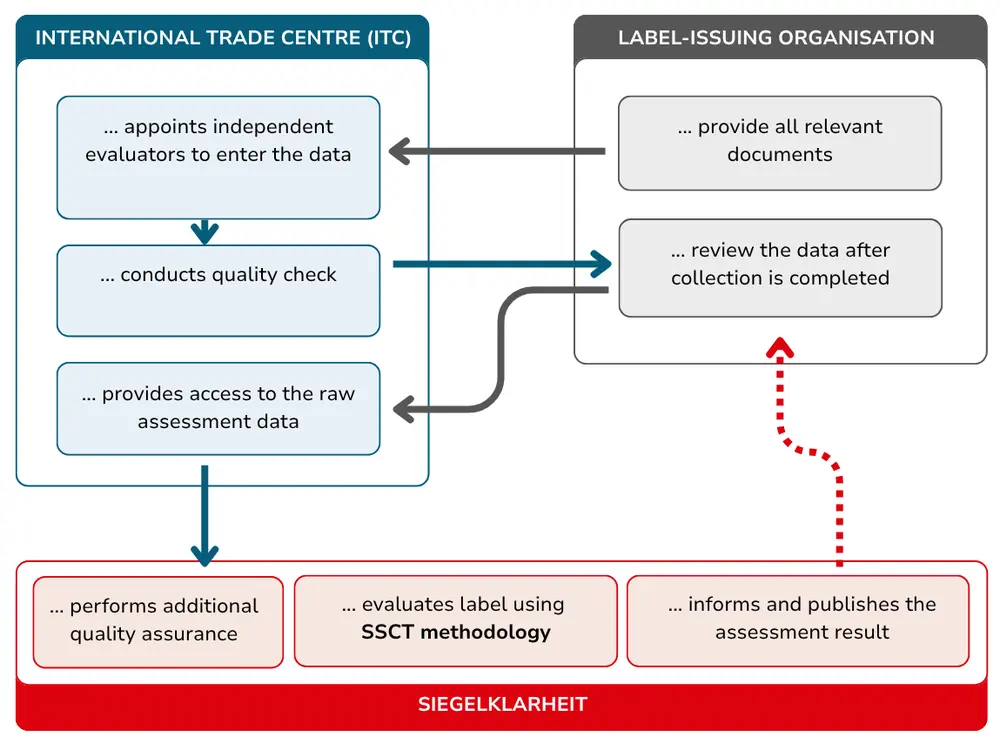

Overview of data collection procedure
Good to know:
The SSCT methodology is applied to varying degrees across three platforms: in addition to Siegelklarheit, it is used on the Kompass Nachhaltigkeit (Sustainability Compass) portal for public procurement, which features a Standard Comparison Tool, and on the KMU Kompass (SME Compass), aimed at small and medium-sized enterprises, to support compliance with corporate due diligence obligations.